From “Who Needs This?” to “We Want to Scale” — Where Operations Integration Comes In

For founders who’ve proven the product but feel the machine falling apart — here’s how to build the operational layer that makes scaling a managed step instead of a scramble.

You validated the idea. You found product-market fit. Revenue is proving both — congratulations, genuinely; most founders never get this far!

Now you need to prove the machine.

The sequence that gets you here is: Validate → Find product-market fit → then, and only then, build the operational infrastructure to scale it.

Validate → Find PMF → Build Operational Infrastructure sequence

The core shift that you and your team are going through is real - from growth (each revenue gain requires proportional increases in labour, oversight, and exceptions) to scaling (the system handles more volume with stronger efficiency and control).

The Problem: Operations Becomes the Ceiling

This is natural, not a failure on your part: operations becomes the binding constraint right after product-market fit, which is exactly when a start-up transitions into growing-business territory — and the sweet spot when integration becomes the right lever to pull.

The business is generating revenue with repeat customers, but it’s hitting an operational ceiling. The founder is still the magician holding everything together by hand. Headcount is increasing faster than capacity. Tool sprawl has set in, and the dots between those tools aren’t connected. Growth is starting to feel like ‘’ rolling a stone uphill ’’, as one SaaS founder put it to me.

Are you experiencing any of these day-to-day?

  • Queues building up in a specific workflow

  • Approvals stalling before work can move forward

  • Materials and chores piling up faster than they clear

  • Communication between teams feeling harder or not flowing

  • Manual data re-entry between systems

  • Handoff delays and major dependencies between jobs

  • Confusion in product development (especially under Agile)

  • Procedures that aren’t standardised, so every team member does it differently

The Cost of Waiting

Without a process review, deliberate tool selection, restructuring, and integration, this tends to compound into chaos: a structure that wobbles under its own growth, mounting errors, churn, burnout, and people leaving. The financial risk follows close behind — costs climb because sales can’t deliver, because operations can’t keep up, because the underlying inefficiency was never fixed.

The Solution: Redesign First, Then Integrate and Automate

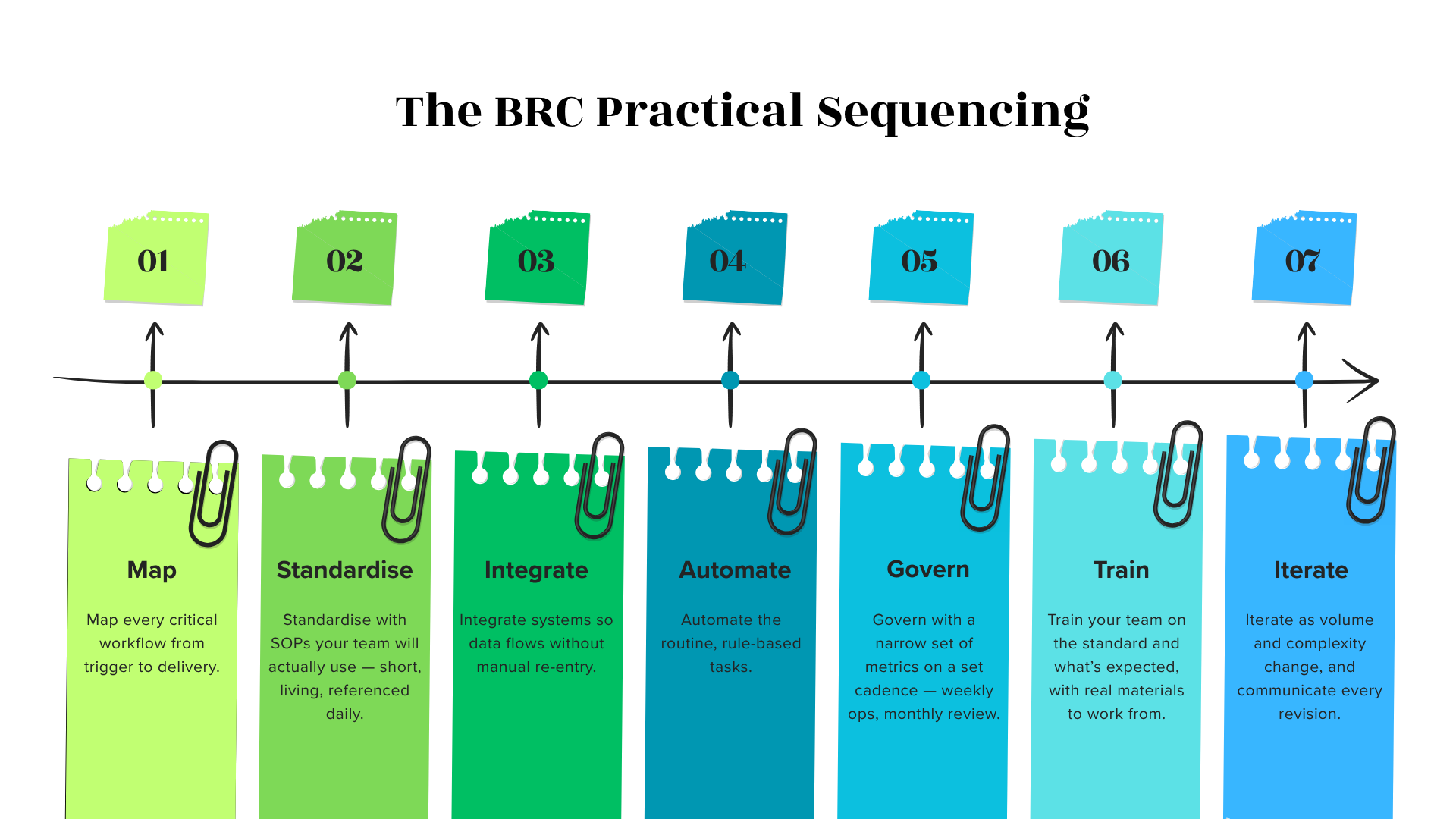
Here’s the distinction that matters most: you redesign the workflow first, and integrate and automate second. That order is the difference between integration that genuinely unblocks growth and integration that just moves the same problem into the next phase of the business.

You don’t need to reinvent operations for every new challenge that shows up as you scale. What you need is one structured, monitored, repeatable operating layer for each function, connected to the bigger picture — so growth becomes a managed step rather than a scramble.
Why Integration Works

It eliminates compounding friction. Every manual handoff, duplicate data entry, or approval chain adds a fixed cost per transaction — and that cost multiplies as volume grows. Integration removes the multiplication: once data flows automatically between systems, the 100th order costs the same to process as the 10th.

It creates a single source of truth. Disconnected tools produce conflicting data. When finance, CRM, and operations each hold a different version of “what’s happening,” decisions slow down, and errors creep in. Integration gives every team the same real-time picture.

It decouples growth from headcount. Without integration, scaling means adding people to cover the gaps — more data entry, more coordination, more firefighting. With integrated workflows, the system absorbs volume, and new product lines, markets, or geographies plug into existing patterns instead of requiring new roles.

It makes bottlenecks visible before they’re painful. Integrated data enables dashboards and alerts that flag cycle-time spikes, error rates, and capacity saturation before they show up as missed deadlines or customer complaints—shifting operations from reactive to proactive.

It accelerates time-to-market. When marketing, product, and operations share connected data, feedback loops shorten. Customer signals flow directly into planning instead of relaying through people, so iteration and response to market shifts both speed up.

It reduces error and rework. Manual transcription between systems is a leading source of defects. Automated data transfer eliminates that entire class of error, protecting margin as you scale.

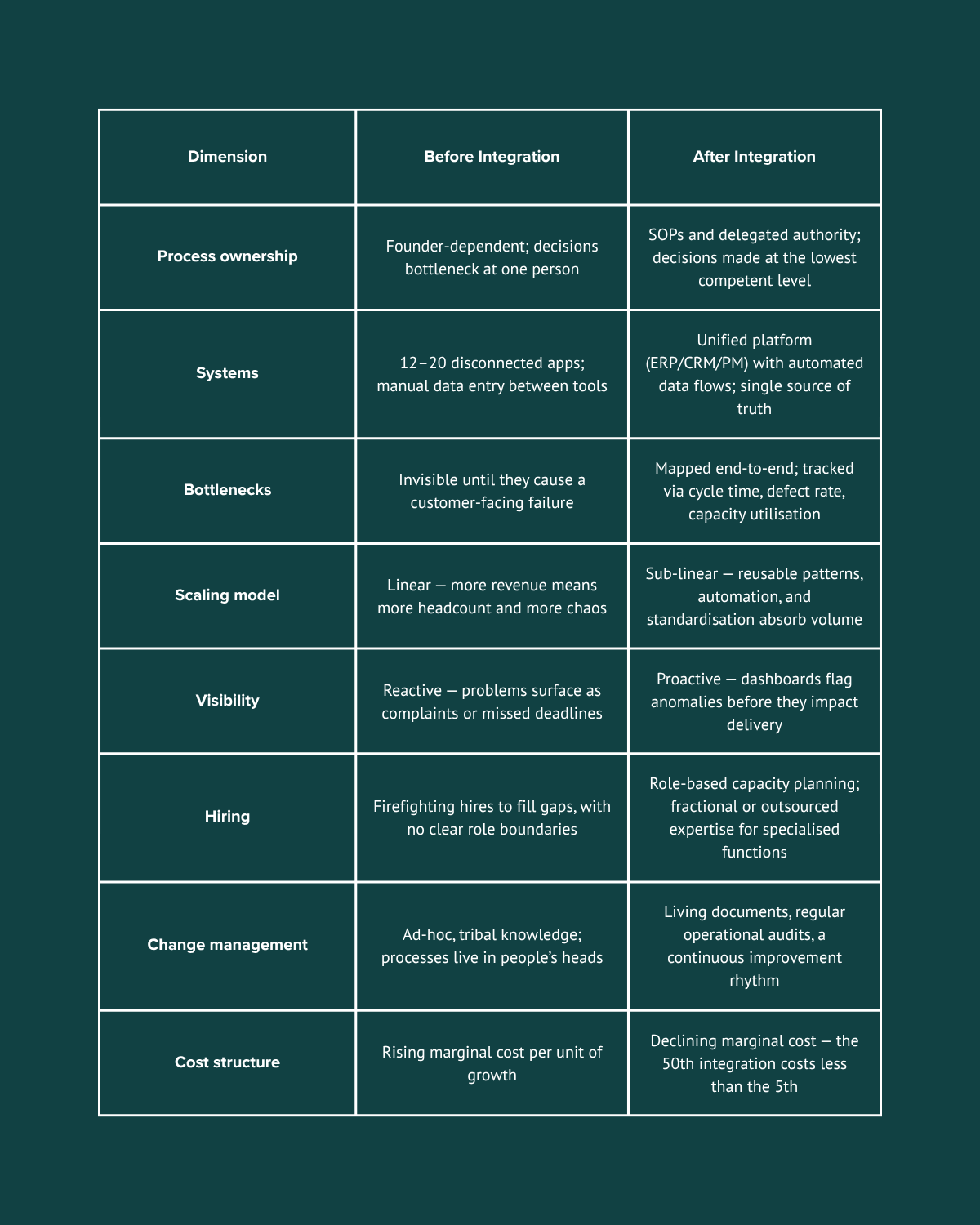
Before & After Integration
Where This Leaves You

You want to scale effectively, but you’re not sure where to start or how to manage it. Maybe one item on that list above is already hitting close to home.

Get in touch, and we’ll review your current phase and needs together, compare notes, and discuss the next steps.

BRC offers embedded execution: a 6–12 month operational partner so visionary founders can go back to what they do best.

Book a discovery call, and let’s talk it through over coffee, tea, matcha, or a protein shake.

Front House, Back House - Why Your Startup's Two Worlds Must Work as One

The investor relations person just secured the funding. The CEO is celebrating. And somewhere in the back house — the operations manager is quietly doing the math on what this means for the business.

Two worlds. One company. And if they’re not talking to each other — the funding that was supposed to get the project off the ground becomes the trigger for a very different kind of crisis.

Every Business Has a Front House and a Back House

The distinction isn’t new. In large organisations it’s formalised: the front office is everyone who faces the market and brings in revenue — sales, account management, marketing, client-facing teams. The back office is everyone who makes that possible — IT, HR, legal, production, finance. The people who go to market versus the people who keep the lights on so the front office can focus entirely on forging value.

I first came across the language working in UK financial services, and saw the exact same split years later at an Australian sales agency — described in almost identical terms by an operations manager who’d never worked in finance. Different industry, same architecture.

So take a moment and ask: what’s the front house and back house in your business?

Who’s out front bringing in the deals and the capital — and who’s behind the scenes making sure the business can deliver on it?

Because once you can name your two houses, the real question is whether they’re talking to each other. Funding is usually what tests that.

IN A START UP CONTEXT

In a startup, it looks the same, just smaller.

Front house: fundraising, investor relations, marketing, sales — the functions focused on growth and external relationships.

Back house: HR, IT, finance, development team, production/manufacturing and delivery — the infrastructure that lets the front house perform.

In a 10-person company, these might not even be formal departments, just responsibilities two or three people share between themselves.

The split still exists, and the need to communicate across it exists from day one — everyone executes.

Funding is the Catalyst

When capital lands in the account, it hits both houses immediately — but differently.

The front house sees fuel:

  1. hire a sales team faster

  2. spend on acquisition

  3. chase bigger partnerships

  4. build the growth narrative for the next round.

The mandate feels obvious — accelerate, and use the new capital as leverage to build a story of momentum for investors.

The back house sees the bills and workflows:

  1. Recruitment has to be managed properly, not just rushed.

  2. Infrastructure that was fine for five people needs to scale.

  3. Processes that were informal and founder-led need to be documented and systematised.

  4. Legal and governance structures need to catch up to having investors, shareholders, and possibly a board.

None of this is glamorous, and none of it shows up in an investor update — but skip it, and everything built on top of it is unstable.

If the two sides are aligned and talking, funding gets the business to its milestones. If they’re not, the gap between vision and execution opens immediately — and it widens quietly, week by week, until the consequences are hard to reverse.


What Actually Goes Wrong

Call it the Revenue Mirage: the company looks like it’s growing — signed contracts, a bigger headcount, upbeat investor updates — while underneath, operations is burning cash and credibility to keep up.

Here’s what that looks like in practice.

The CEO and Operations stop talking. The CEO — the visionary, the face of the company, the one who closed the round — keeps plans and direction in their own head. Decisions are made without consulting the operations team, and execution is expected to happen by instinct, as if the team could read the CEO’s mind. Operations ends up building infrastructure for a version of the company that no longer matches the CEO’s current thinking. When deliverables are missed or timelines slip, the CEO is genuinely surprised and frustrated. This usually isn’t a character flaw — it’s a communication and people-management issue that founders need to develop skills around as they move from builder to leader. Left unaddressed, it becomes one of the most expensive cause-and-effect situations in a post-funding startup.

Sales promises what Ops hasn’t approved. New capital brings pressure to show momentum, and sales teams — encouraged to hit targets and demonstrate traction to investors — start promising features, timelines, and capabilities the back house hasn’t validated and can’t yet deliver. When those promises break, it’s not just a lost client. It’s active churn (i.e., cancelled subscriptions), negative reviews that erode the reputation in nappies, and a back office pulled into permanent firefighting mode instead of building scalable architecture and following the agreed roadmap. A blame culture manifests: sales says operations is too slow, operations says sales is reckless. Turnover climbs in exactly the delivery roles the business can least afford to lose.

Nobody’s watching the real numbers. Marketing and investor relations celebrate signed contracts and new client wins, and the investor update looks positive. Meanwhile, finance and operations — who comprehend payment terms, delivery costs, and what it takes to service those contracts — are watching a different reality: unpaid invoices accumulating, delivery costs bleeding cash faster than expected, runway shortening despite what the topline suggests. For subscription businesses, this shows up differently but just as dangerously — recurring revenue can feel like security even while the cost of servicing each subscriber quietly exceeds what they pay. Without that feedback loop running both ways, marketing keeps spending to acquire customers the business can’t afford to serve.

The roadmap gets hired for the wrong future. Investor relations proposes a roadmap that requires specific capabilities down the line — a new analytics tool, a proprietary integration, a scaled customer success function. But HR and IT, who weren’t in the room when those commitments were made, recruit for today’s stack rather than tomorrow’s need. By the time the misalignment becomes visible, months of runway have gone into headcount that doesn’t match the plan, and course-correcting means expensive layoffs right when the business needs consistency and solid execution of the agreed plan.

Run like this for six to nine months, and the pattern shows up in the metrics: high churn, negative unit economics, a burnt-out team stuck in firefighting mode, a product roadmap behind schedule, and investors asking questions the leadership team cannot answer with confidence. That’s the Series B Trap — and it’s rarely a product or a market problem. The company can’t raise its next round because it can’t prove that the capital was deployed efficiently or that the organisation can execute at the next level. It reveals the truth — the front house and back house were not properly integrated after the funding closed.


What the Solution Looks Like

Avoiding this isn't about working harder in either house — it's about a clever person deliberately holding both together.

That starts with treating investor relations as an ongoing operational function rather than an occasional event: a real reporting rhythm, monthly updates, quarterly board meetings, and honest communication about challenges before investors have to ask. Investors who are surprised by bad news can lose trust; investors who are kept informed, even when the news is difficult, become genuine partners in solving problems.

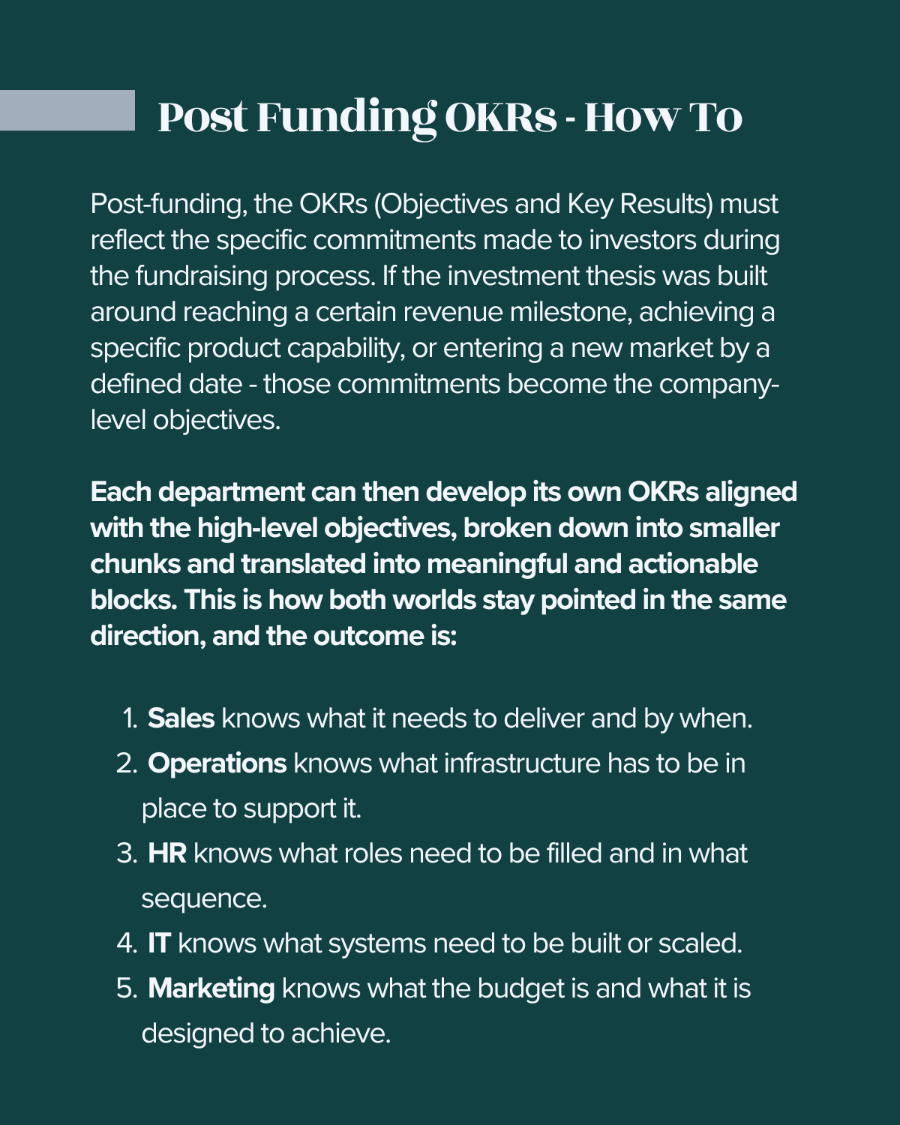
It also means translating the CEO's vision into a document the whole business can execute against. This is done by establishing a business plan, developing a strategic plan and using OKRs that provide every department with a shared, measurable direction.

For a post-funding startup, the sharpest tool is the Thesis-Driven Objective: instead of generic growth targets, the company-level objective should map directly to the specific hypothesis investors funded — proving or disproving the thesis behind the valuation, rather than chasing metrics that sound good but don't move the needle on what was actually promised.

Objectives don't need to be complicated to work. Three things done exceptionally well will always outperform ten things done poorly.

Aligning Both Houses Around Vision, Strategy and OKRs is the role of a Business Integrator — the professional who sits with the CEO in the front house and simultaneously navigates the building of the operational infrastructure in the back house. Then the story investors are hearing, and the reality operations are living, are the same business.


Securing an investment is a milestone, not a destination. It’s the moment the real operational work begins — building the infrastructure, aligning the teams with systems and workflows, and executing with the discipline investors trusted you to demonstrate when they wrote the cheque. The startups that make it through this transition are rarely the ones with the best product, the biggest round or the strongest social media presence — they’re the ones with the operational alignment to execute the vision, mission and plan.

If your startup has recently closed a round — or is preparing to — and you want the operational foundation in place before the Revenue Mirage takes hold, that’s exactly the conversation BRC is built for.