Front House, Back House - Why Your Startup's Two Worlds Must Work as One

The investor relations person just secured funding. The CEO is celebrating. And somewhere in the back house — the operations manager is quietly doing the math on what this means for the business.

Two worlds. One company. And if they're not talking to each other — the funding that was supposed to get the project off the ground becomes the trigger for a very different kind of crisis.

What is the Front House and the Back House?

The front house and the back house are not new concepts. It has existed in business for decades - and if you have worked inside a large organisation, you will recognise it.

In corporations, where this language is most established, the front office generates the revenue:

  • Investment management

  • Trading and brokerage

  • Account management

  • Customer service and support

  • Marketing, Sales and Public Relations

The people and functions that go to the market, talk to prospects, secure new clients, and bring money into the business (generate profit, earn revenue through commissions, make sales).

The back office is all the activities that support the front office:

  • Information Technology (IT)

  • Human Resources (HR)

  • Legal and Compliance

  • Operations and Supply Chain Management

  • Facility Management / Corporate Real Estate

The departments that keep the lights on, the systems and software running, and correct admin in place so that the front office can focus entirely on forging value.

I encountered this division firsthand working in the UK financial sector - and later saw the same playing out in a different context when working with an Australian sales agency. The operations manager, a former marketing executive from a corporation, described her world in the same terms. The sales team was in the front house. Operations and service delivery were the back house.

The industry was different. However, the applied language and the principle were the same.

The front house secures funding and makes money.

The back house makes sure everything runs so the front house can perform.

IN A START UP CONTEXT

The front house typically includes Fundraising, Investor Relations, Marketing and Sales  - the functions that focus on growth, revenue, and external relationships.

The back house includes HR, IT, Finance and any Production, Manufacturing and Delivery/Fulfillment. This is the infrastructure that supports and enables the front house to run their show and the business to operate as a whole.

In a small startup of 10 people, back-office functions may not be formal departments. They may be roles - or even just responsibilities shared between two or three people.

But the distinction between front- and back-end activities exists regardless of headcount.

The need to communicate, cooperate, and align on common business objectives is present from day one. Everyone executes.

Funding is the Catalyst - And the Operational Test

For most startups, securing an investment is the pivotal moment.

It is the transition from idea to enterprise. From building in survival mode to building with safety. From proving the concept to executing the vision.

But funding is not just a financial event. It is an operational affair.

When the capital lands in the bank account, both ‘houses' are immediately affected, however in different ways.

THE FRONT HOUSE

The front house sees opportunities and views the funding as a fuel for revenue generation

Perceives an immediate mandate to accelerate growth and execute the go-to-market strategy

  • Hiring Account Executives, Sales Development Representatives, and Marketing Managers to increase the company's capacity to close deals. These are revenue-generating seats.

  • Scaling Customer Acquisition (increasing ad spend, launching campaigns, attending industry conferences, and investing in tools previously too expensive).

  • Pursuing Strategic Partnerships and Business Development with larger, more strategic partnerships that were previously out of reach.

  • Driving Product-Market Fit Validation and Expansion by funding beta programs, customer research, and pilot launches to ensure the product roadmap aligns with what the market will pay for, directly influencing the company's valuation for the next round.

  • Building Investor Relations and Narrative to maintain investor confidence by crafting a narrative of "smart growth," showing early wins from the new capital, and setting the stage for the next funding round or an exit event. The front office sees the capital not just as cash, but as leverage to build a story of momentum.

THE BACK HOUSE

The back house sees complexity and faces the operational reality

  • Recruitment needs to be managed.

  • Infrastructure needs to be built or scaled.

  • Processes that were informal and founder-led need to be documented and systematised.

  • Legal and governance structures need to be updated to reflect the new reality of having investors, shareholders, and board members.

  • The production site needs to be properly set up (i.e. in manufacturing).

  • And maybe a new, more suitable office space could be found and rented for the next couple of years.

If the front house and back house are aligned and communicating clearly, the funding gets the business up to speed to reach its significant milestones.

If they are not, the gap between vision and execution opens immediately. And it widens silently, week by week, until the consequences become impossible to ignore.


The Immediate Operational Cascade After Funding

The first weeks after a funding round closes are critical. They set the operational foundation for everything that follows — and most startups underestimate how much needs to happen, how quickly.

1. Cash Management and Financial Infrastructure

The immediate priority is to ensure the capital is properly managed and that the financial infrastructure is in place to track its use. This means dedicated operating accounts, corporate credit cards that separate business and personal expenses, and a bookkeeping system — whether through a dedicated accountant, a fractional CFO, or a reliable platform like Xero or QuickBooks — that accurately tracks the burn rate and prepares the business for future audits.

This is not glamorous work. But it is the foundation of every other decision that follows. A startup that does not know its monthly cash consumption cannot make informed decisions about hiring, marketing spend, or product development.

2. Legal and Governance Updates

Funding changes the legal structure of the business. Shareholders' agreements need to be finalised. The Capitalisation Table document (cap table) needs to be updated to reflect new ownership percentages. Stock certificates need to be formally issued. If investors have secured board seats — which is common at Series A and beyond — the first board meeting needs to be scheduled promptly to ratify the funding and establish the governance framework going forward. The Cap Table needs to be updated after every funding round.

3. Accelerated Hiring

Between 60 and 80 per cent of the capital raised typically goes toward salaries. This makes hiring the single largest operational decision post-funding, and the one most likely to go wrong when front and back house are not aligned.

The front house — driven by growth ambition — wants people in seats quickly. The back house — responsible for IT setup, onboarding infrastructure, role documentation, and workplace or remote-working arrangements — needs time to properly prepare for each new hire.

When these two realities are not coordinated, hiring becomes reactive rather than strategic. The wrong people get hired for the wrong roles because management has not defined what needs to be done and what should be included in a role. New team members arrive to find a floppy onboarding process, no equipment and no documented responsibilities. And the cost - financial, operational, and cultural- compounds rapidly.

Hiring at this stage should be a strategic exercise. The focus should be on quality team building by the COO (Business Integrator) & CEO together — and every role should be clearly defined (including merit) before recruitment begins.

4. Process Scaling

The informal, founder-led processes that carried the business through its early stage cannot carry it through what comes next. Documented procedures need to replace institutional knowledge. Scalable tools for business project management, customer acquisition and relationship, and internal communication need to be implemented deliberately — not added reactively when something breaks.

This is precisely what Bora Remis Consulting specialises in. The transition from informal to formal operations → from founder-dependent to system-operating → is not something most startups can manage on their own. It requires a professional who has done it before, understands both the strategic intent and the operational requirements, and can build the infrastructure that enables the vision to be executed.


What Happens When Front and Back House Stop Talking

This is the section many founders wish someone had shown them earlier.

When the front house and back house fail to communicate properly after funding, the result is rarely immediate collapse. It is something more insidious - a rapid, silent erosion of value that is often visible when it is already too late to prevent.

Call it the Revenue Mirage. The company appears to be growing on paper - meaning signed contracts, investor updates full of positive momentum, a headcount that looks impressive. However, beneath the surface, the operational reality is causing a cash burn. Soon, the lack of credibility and a potential reputation crisis threaten the next funding round.

HERE IS WHAT IT LOOKS LIKE IN PRACTICE

1. The CEO and Operations Team Are Not Talking

The common and damaging dynamic is simple: the CEO — the visionary, the face of the company, the person who closed the funding round — does not share information with Operations. Plans, directions, and expectations stay in their head. Decisions get made without operational input. Execution is expected to happen as if by instinct or magical mindreading.

The business starts running on assumptions rather than clear instructions. The operations manager is building infrastructure for a version of the company that may no longer reflect the CEO's current thinking. And when things are not done, when deliverables are missed, or timelines slip, the CEO is genuinely surprised and frustrated.

This is not always a character flaw. It can be a skills and maturity gap → a communication and people management capability that founders need to develop as they transition from builder to leader. But unaddressed, it is one of the most expensive gaps in a post-funding startup.

2. The Promise-Delivery Gap

With new capital comes pressure, and with pressure comes the temptation to sell aggressively. Sales teams, encouraged to hit targets and demonstrate momentum to investors, promise features, timelines, and capabilities that the back house has not validated and cannot yet deliver.

When those promises fail to materialise, the consequence is not just an unhappy client. It is:

  • Active churn.

  • Negative reviews that poison the pipeline.

  • A back-office forced into permanent firefighting mode (diverting resources from the strategic roadmap to fix broken implementations, which causes a slowing down of the growth the funding was meant to accelerate).

Simultaneously, a blame culture develops. Sales blames Operations for being too slow. Operations blames Sales for being reckless and having unrealistic expectations. This internal friction leads to high turnover in critical delivery roles — Customer Success Managers, Product Developers, Manufacturing/Production Analysts, Project Leads — further degrading the company's ability to execute the business plan.

3. The Cash Flow Illusion

Marketing and Investor Relations celebrate signed contracts and new client wins. The investor update looks positive. But Finance and Operations - who understand payment terms, the delivery costs, and the infrastructure required to service those contracts - are navigating a different reality:

  • Unpaid invoices accumulate.

  • Unanticipated delivery costs bleed cash faster than expected, shortening the runway - sometimes significantly - despite what the revenue figures suggest.

  • For subscription-based businesses, the dynamic is different but equally dangerous. Recurring revenue can create a false sense of financial security when Customer Attrition / Dropp-out / Loss is happening, and the cost of servicing each subscriber exceeds the monthly fee they pay.

Without regular communication between front and back house, Marketing continues to spend on acquiring new customers at a rate the business cannot afford to sustain. If Operations hasn't flagged that the cost of winning and serving each customer surpasses the revenue they generate, Marketing keeps spending, burning through the funding round far faster than planned, without building proportional value in return.

4. The Empty Seat Bottleneck

The investor relations team proposes a roadmap to investors that requires specific technical capabilities: a new tool-driven analytics by Q4, a proprietary integration layer, a scaled customer success function. But HR and IT, who were not in the room when those commitments were made, hire for the current stack rather than the future need.

By the time the gap between what was promised and what was hired for becomes visible, months of runway have been consumed on misaligned headcount. Course corrections are expensive. Layoffs damage culture and reputation. And the roadmap that secured the funding falls further behind with every passing week.

5. The Series B Trap

Six to nine months post-funding, the metrics reveal the truth - that the Revenue Mirage concealed.

1. High customer turnover (churn).

2. Negative unit economics (loss of money on every single unit you sell or every customer you acquire).

3. A burnt-out team operating in firefighting mode.

4. A product development that is behind schedule.

5. And investors asking questions that the IR, CEO & COO cannot answer with confidence.

The company finds itself unable to raise Series B; not because the product is wrong or the market has disappeared, but because:

  • it cannot prove concept and start to profit.

  • It cannot demonstrate that the capital was deployed efficiently.

  • It cannot show that the organisation is aligned and capable of executing at the next level.

This is the Series B Trap. And it can be the result of one thing: a front house and back house not properly integrated after the funding closed.

This is BRC's sweet spot. The Business Integrator who understands both worlds → who can sit with the CEO in the front house and build the operational infrastructure in the back house simultaneously. BRC is the professional a post-funding startup needs to avoid the Revenue Mirage.


Investor Relations as an Operational Function

One of the most important mindset shifts a post-funding founder needs to make is this: investor relations is no longer an occasional activity. It is a formal, recurring operational function — and it requires the same discipline and consistency as any other core business process.

This means:

  • Establishing a clear reporting rhythm.

  • Monthly investor updates.

  • Quarterly board meetings.

  • Consistent communication that covers key metrics, cash runway, major wins, and transparent discussion of challenges.

Investors who are surprised by bad news lose trust. Investors who are kept informed, even when the news is difficult, become genuine partners in solving problems.

Managing these relationships effectively requires a specific set of skills:

  1. the ability to communicate with clarity and confidence under pressure,

  2. to maintain trust during difficult periods

  3. to represent the business honestly without undermining confidence.

This is a capability I bring directly to engagements. Prior to establishing Bora Remis Consulting, I spent almost two years in Middle Eastern private banking - building and managing relationships with up to 50 ultra-high-net-worth individuals.

The discipline of relationship management at that level, the precision of communication, the importance of trust, and the ability to navigate complexity while maintaining confidence translate directly to the investor relations function in a post-funding startup.

In practice, the CEO and the Business Integrator work together on investor relations:

  • The CEO is the Visionary - the face of the company, the holder of the strategic narrative.

  • The Business Integrator is the operational partner - ensuring that the metrics, the reporting, and the execution reality behind the narrative are accurate, consistent, and credible.


Aligning Both Houses Around Vision, Mission and OKRs

For the front house and back house to work as one, they need to be pointed in the same direction. And that direction comes from the top → from the CEO and leadership team, who are responsible for communicating the vision, mission, and strategy clearly and consistently to every function in the business.

This is a bigger job than most founders comprehend. And it is one of the areas where the CEO and Business Integrator work most closely together.

The CEO holds the vision. The Integrator closes the gap between where the business is today and where it needs to be - through strategy documentation, OKR development, and operational alignment that translates high-level ambition into department-level clarity.

THESIS DRIVEN OBJECTIVES

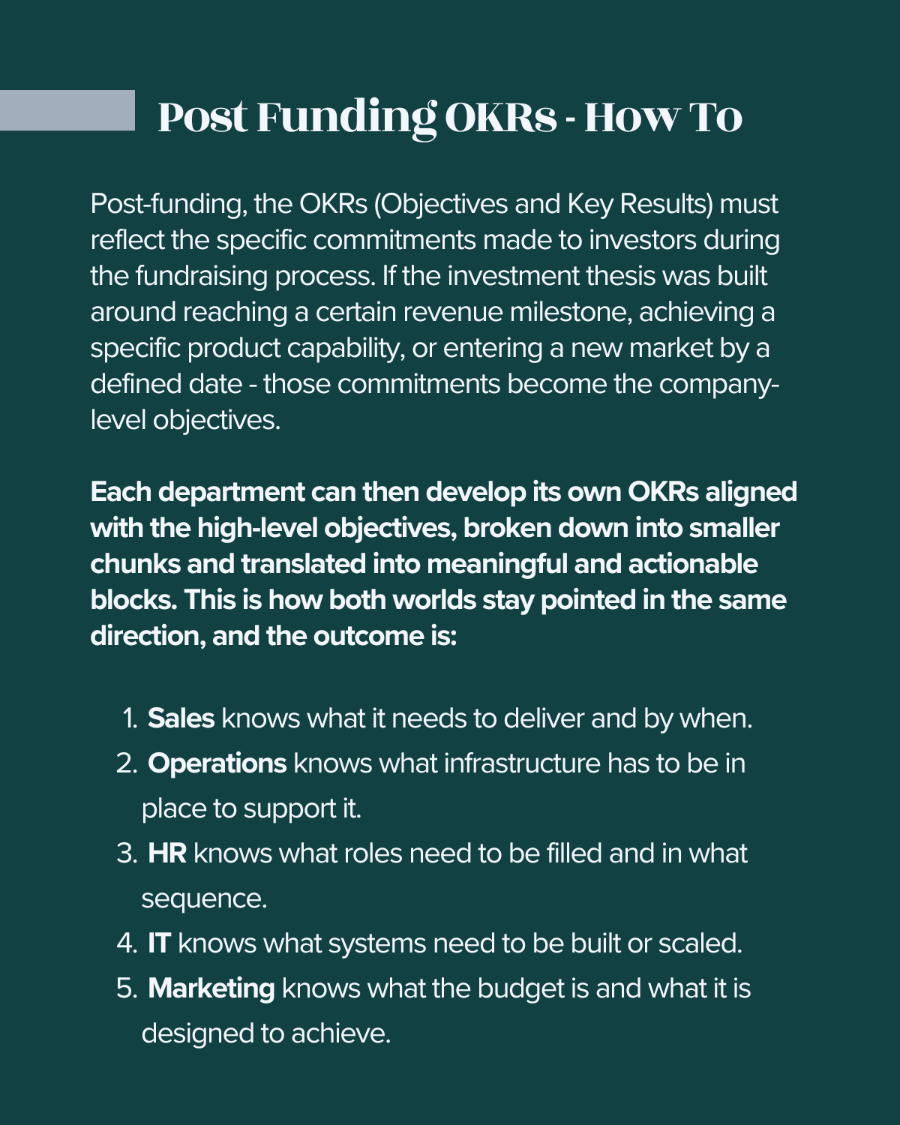
Thesis-Driven Objectives align a startup’s operational goals directly with the specific hypothesis an investor is funding. Instead of generic growth targets, the company-level objective is designed to prove or disprove the core assumption (the "thesis") that justified the investment valuation. *

The company-level objective should reflect the core promise made to investors (e.g., "Validate Product-Market Fit at Scale" or "Establish Market Leadership in Segment X"). This ensures that every dollar spent is driving toward the valuation inflexion point agreed upon in the term sheet. *

* Sources: medium.com, reddit.com, entrepreneur.com, forbes.com

The front house and back house working as one does not happen by default. It has to be designed, communicated, and actively managed. That is what the Business Integrator - sitting at the intersection of vision and execution - makes possible.

A word of caution for early-stage founders: OKRs do not need to be complex to be effective. Many businesses overthink their goal-setting frameworks and end up with documents nobody reads and metrics nobody tracks. Three things done exceptionally well will always outperform ten things done poorly.


Is Your Startup Ready for What Funding Demands?

Securing investment is a milestone. But it is not the destination.

It is the moment the real operational work begins — the work of building the infrastructure, aligning the teams, integrating the functions, and executing with the discipline and consistency that investors trusted you to demonstrate when they wrote the cheque.

The startups that navigate this transition successfully are not necessarily the ones with the best product or the biggest round. They are the ones with the operational alignment to make the vision real — a front house and back house that communicate, cooperate, and move together toward the same objectives.

If your startup has recently closed a round — or is preparing to — and you want to ensure the operational foundation is in place before the Revenue Mirage takes hold, this is exactly the conversation BRC is built for.

Book a free 30-minute discovery call and let's look at where your operations stand today and what needs to be in place before the next phase of growth begins.