Front House, Back House - Why Your Startup's Two Worlds Must Work as One

The investor relations person just secured the funding. The CEO is celebrating. And somewhere in the back house — the operations manager is quietly doing the math on what this means for the business.

Two worlds. One company. And if they’re not talking to each other — the funding that was supposed to get the project off the ground becomes the trigger for a very different kind of crisis.

Every Business Has a Front House and a Back House

The distinction isn’t new. In large organisations it’s formalised: the front office is everyone who faces the market and brings in revenue — sales, account management, marketing, client-facing teams. The back office is everyone who makes that possible — IT, HR, legal, production, finance. The people who go to market versus the people who keep the lights on so the front office can focus entirely on forging value.

I first came across the language working in UK financial services, and saw the exact same split years later at an Australian sales agency — described in almost identical terms by an operations manager who’d never worked in finance. Different industry, same architecture.

So take a moment and ask: what’s the front house and back house in your business?

Who’s out front bringing in the deals and the capital — and who’s behind the scenes making sure the business can deliver on it?

Because once you can name your two houses, the real question is whether they’re talking to each other. Funding is usually what tests that.

IN A START UP CONTEXT

In a startup, it looks the same, just smaller.

Front house: fundraising, investor relations, marketing, sales — the functions focused on growth and external relationships.

Back house: HR, IT, finance, development team, production/manufacturing and delivery — the infrastructure that lets the front house perform.

In a 10-person company, these might not even be formal departments, just responsibilities two or three people share between themselves.

The split still exists, and the need to communicate across it exists from day one — everyone executes.

Funding is the Catalyst

When capital lands in the account, it hits both houses immediately — but differently.

The front house sees fuel:

  1. hire a sales team faster

  2. spend on acquisition

  3. chase bigger partnerships

  4. build the growth narrative for the next round.

The mandate feels obvious — accelerate, and use the new capital as leverage to build a story of momentum for investors.

The back house sees the bills and workflows:

  1. Recruitment has to be managed properly, not just rushed.

  2. Infrastructure that was fine for five people needs to scale.

  3. Processes that were informal and founder-led need to be documented and systematised.

  4. Legal and governance structures need to catch up to having investors, shareholders, and possibly a board.

None of this is glamorous, and none of it shows up in an investor update — but skip it, and everything built on top of it is unstable.

If the two sides are aligned and talking, funding gets the business to its milestones. If they’re not, the gap between vision and execution opens immediately — and it widens quietly, week by week, until the consequences are hard to reverse.


What Actually Goes Wrong

Call it the Revenue Mirage: the company looks like it’s growing — signed contracts, a bigger headcount, upbeat investor updates — while underneath, operations is burning cash and credibility to keep up.

Here’s what that looks like in practice.

The CEO and Operations stop talking. The CEO — the visionary, the face of the company, the one who closed the round — keeps plans and direction in their own head. Decisions are made without consulting the operations team, and execution is expected to happen by instinct, as if the team could read the CEO’s mind. Operations ends up building infrastructure for a version of the company that no longer matches the CEO’s current thinking. When deliverables are missed or timelines slip, the CEO is genuinely surprised and frustrated. This usually isn’t a character flaw — it’s a communication and people-management issue that founders need to develop skills around as they move from builder to leader. Left unaddressed, it becomes one of the most expensive cause-and-effect situations in a post-funding startup.

Sales promises what Ops hasn’t approved. New capital brings pressure to show momentum, and sales teams — encouraged to hit targets and demonstrate traction to investors — start promising features, timelines, and capabilities the back house hasn’t validated and can’t yet deliver. When those promises break, it’s not just a lost client. It’s active churn (i.e., cancelled subscriptions), negative reviews that erode the reputation in nappies, and a back office pulled into permanent firefighting mode instead of building scalable architecture and following the agreed roadmap. A blame culture manifests: sales says operations is too slow, operations says sales is reckless. Turnover climbs in exactly the delivery roles the business can least afford to lose.

Nobody’s watching the real numbers. Marketing and investor relations celebrate signed contracts and new client wins, and the investor update looks positive. Meanwhile, finance and operations — who comprehend payment terms, delivery costs, and what it takes to service those contracts — are watching a different reality: unpaid invoices accumulating, delivery costs bleeding cash faster than expected, runway shortening despite what the topline suggests. For subscription businesses, this shows up differently but just as dangerously — recurring revenue can feel like security even while the cost of servicing each subscriber quietly exceeds what they pay. Without that feedback loop running both ways, marketing keeps spending to acquire customers the business can’t afford to serve.
The roadmap gets hired for the wrong future. Investor relations proposes a roadmap that requires specific capabilities down the line — a new analytics tool, a proprietary integration, a scaled customer success function. But HR and IT, who weren’t in the room when those commitments were made, recruit for today’s stack rather than tomorrow’s need. By the time the misalignment becomes visible, months of runway have gone into headcount that doesn’t match the plan, and course-correcting means expensive layoffs right when the business needs consistency and solid execution of the agreed plan.

Run like this for six to nine months, and the pattern shows up in the metrics: high churn, negative unit economics, a burnt-out team stuck in firefighting mode, a product roadmap behind schedule, and investors asking questions the leadership team cannot answer with confidence. That’s the Series B Trap — and it’s rarely a product or a market problem. The company can’t raise its next round because it can’t prove that the capital was deployed efficiently or that the organisation can execute at the next level. It reveals the truth — the front house and back house were not properly integrated after the funding closed.


What the Solution Looks Like

Avoiding this isn't about working harder in either house — it's about a clever person deliberately holding both together.

That starts with treating investor relations as an ongoing operational function rather than an occasional event: a real reporting rhythm, monthly updates, quarterly board meetings, and honest communication about challenges before investors have to ask. Investors who are surprised by bad news can lose trust; investors who are kept informed, even when the news is difficult, become genuine partners in solving problems.

It also means translating the CEO's vision into a document the whole business can execute against. This is done by establishing a business plan, developing a strategic plan and using OKRs that provide every department with a shared, measurable direction.
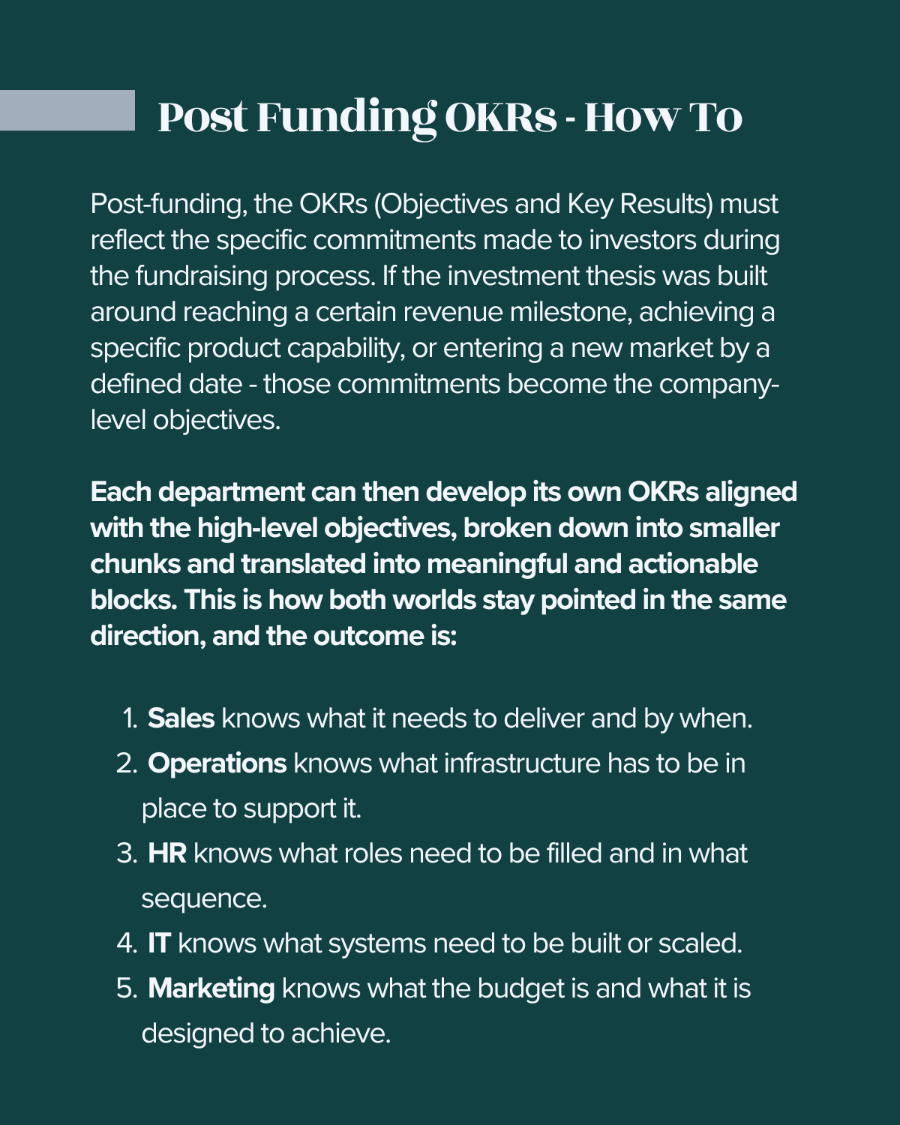
For a post-funding startup, the sharpest tool is the Thesis-Driven Objective: instead of generic growth targets, the company-level objective should map directly to the specific hypothesis investors funded — proving or disproving the thesis behind the valuation, rather than chasing metrics that sound good but don't move the needle on what was actually promised.

Objectives don't need to be complicated to work. Three things done exceptionally well will always outperform ten things done poorly.

Aligning Both Houses Around Vision, Strategy and OKRs is the role of a Business Integrator — the professional who sits with the CEO in the front house and simultaneously navigates the building of the operational infrastructure in the back house. Then the story investors are hearing, and the reality operations are living, are the same business.


Securing an investment is a milestone, not a destination. It’s the moment the real operational work begins — building the infrastructure, aligning the teams with systems and workflows, and executing with the discipline investors trusted you to demonstrate when they wrote the cheque. The startups that make it through this transition are rarely the ones with the best product, the biggest round or the strongest social media presence — they’re the ones with the operational alignment to execute the vision, mission and plan.

If your startup has recently closed a round — or is preparing to — and you want the operational foundation in place before the Revenue Mirage takes hold, that’s exactly the conversation BRC is built for.


Why Fast-Growing Startups Hit an Operational Wall and What Is The Real Cost

Growth brings more clients, a faster pace, larger teams, and increased revenue. Yet for many expanding Startups, this progress also creates significant pressure and frustration.

  • Deadlines slip.

  • Teams are stretched thin.

  • Business administration becomes disorganized.

  • The founder is absorbed in operations, and progress toward key objectives stalls.

This is the operational wall almost every fast-growing business hits, and the question is:

Do we see it coming before it costs us more than we realise?  How do we handle it?

What is the Operational Wall?

The operational wall is the point at which a business's internal systems can no longer support its external growth.

Before it shows up in the numbers, it shows up as a feeling.

→ It's the Sunday night dread before another week of firefighting.

→ It's the founder who hasn't taken a proper day off in months and still feels behind schedule.

→ It's the team that arrives early, stays late, and somehow can't meet objectives.

→ It's the gnawing sense that no matter how hard everyone works, the business is running them, not the other way around.

Hitting an operational wall feels like pushing a bicycle and suddenly getting stuck. We want to move forward with full effort, but it’s impossible. Stress and frustration accumulate. Anxiety becomes a background vibration. The energy that has built the business starts to feel like it's being consumed just to keep it standing still.

In organisational terms, this manifests as burnout and stagnation. A state in which depleted resources, mounting pressure, and the absence of a proper system prevent the business from reaching a significant milestone.

The wall builds gradually from undocumented processes, undefined roles, tools added reactively rather than strategically, and a leadership structure designed for a ten-person team trying to operate a forty-person business.

For a while, the energy and drive of a growing startup mask these issues. Teams work harder to compensate. The founder(s) fill in wherever things break. A culture of busyness develops that feels productive but is quietly burning through time, money, and people.

Then it begins to show up:

  • A big client raises concerns.

  • A critical project cannot take off.

  • A key team member leaves.

What felt like momentum and plan in action feels like chaos and stagnation.

Why It Happens - The 7 Events Causing Problems

Hitting a performance wall does not happen randomly. There are recognizable, predictable reasons and understanding them is the first step of prevention. Here are the 7 unhealthy dynamics to watch out for:

1. Communication Breakdown

When a startup grows beyond its initial size, typically around 10 employees and contributors, the informal communication that made the early team effective begins to break down. What worked through corridor conversations and shared instinct becomes inefficient at scale.

  • Information lives in the team's energy field.

  • Team members act based on assumptions.

  • Decisions are slow due to a lack of clarity and accurate data.

  • Roles and responsibilities blur together.

2. Lack of Clear Roles and Ownership

This is my personal favorite to fix. Without defined roles and responsibilities, teams fall into confusion, and decision-making becomes a conversation with everyone involved; however, actions are not assigned to individuals. The result is disorder, unclear tasks, repetitive work and tiredness.

Therefore, a team lead, manager, or specific role holder must be appointed to ensure the team’s efforts meet the standards and key objectives.

3. Founder Transition Failure

One of the most common problems in a growing startup is the founder's failure to evolve from a hands-on team member to a strategic, accountable leader. This transition requires personal growth, establishing authority, setting direction, communicating the vision, mission, and strategy, making decisions, and caring for people — skills and behaviours that are entirely different from the fragmented execution that built the business in the first place. When this transition doesn't happen, the result is organisational drift — a business that has technically grown but still operates with the founder working as a team member.

4. Unresolved Conflict

Founding teams frequently fracture over unresolved matters — equity disputes, unspoken expectations and roles that were never officially agreed upon.

A lack of trust, poor communication, and paperwork delays → High turnover follows.

In a startup environment, every person carries significant operational weight; losing key people can set the entire business back by months.

5. Technical and Process Debt

Rapid builds, shortcuts, and workarounds accumulate into technical and process debt. Start-ups and SMEs are using systems that were never designed to scale; the workflows patched together under pressure, tools purchased on assumptions, subscriptions bought just because another Start-up has it.

Slowly but surely, the architecture becomes unstable, and the debt blends into daily business. This is particularly unhealthy as it makes the system and operations slow and fragile. Organisational re-design is inevitable.

6. No Objectives & Key Results

Teams without defined objectives do not perform in alignment with the company’s goals.

When priorities aren't set, people work hard on the wrong things, and energy and focus are scattered. And we all know that effort should be directed at the desired outcomes.

Specifying the objectives and key results is essential to people engagement, performance, and progress. The leadership ought to break down the yearly company goals and strategy and write quarterly OKRs for each department / team.

7. Burnout

" Always on & available " culture that many startups celebrate in their early stages becomes a disadvantage at scale. Constant overload, pressure, and push cause burnout. It manifests as disengagement, emotional strain, declining performance, and eventually, the contributors who have built the business leave.  

Investment in people's care, well-being, and development is critical. When leadership does not trust and care for their people, they feel it, and often the best ones leave first.

Nowadays, the cost of Hustle Culture extends beyond physical exhaustion, fundamentally eroding mental and emotional well-being and creating a system of auto-exploitation in which individuals internalise work demands as personal moral failures.

The Obsession Most Startups Misunderstand

Here is the uncomfortable truth that most startup founders don't want to hear when they're riding the enthusiasm wave:

— You cannot have stable and growing sales without excellent customer service.

— And you cannot deliver excellent customer service if your operations are not set up for the purpose.

Your front and back house have to communicate and collaborate to make things work well.

  • Pure focus on sales, marketing, and growth — before the operational foundation is in place — is the most common and costly strategy a new business executes.

  • Operations are the systems, processes, SOPs, software, tools, and people — Ideally, these elements are aligned, and you create a customer-centered organisation with smooth operations.

Such a mechanism allows you to scale while having marketing and sales speak directly to the customer/buyer, their needs, pain points, and desires. The reality is that investors don’t put their money into a wobbly structure and reactive management, no matter how compelling the business idea and how impressive the pitch deck.

If you want to scale sustainably, you need to become obsessed with operations and customer service before expanding.

The Real Costs Of Hitting The Wall

When we think about the cost of operational inefficiency, we usually think about delayed logistics, wasted resources, and budget problems. Those are real, yes. However, the highest costs for growing a start-up are:

1. Staffing and People

Every new hire triggers a chain of hidden costs — onboarding, training, lost productivity. When processes aren't documented, and roles aren't clear, that ramp-up period can stretch into months. Add payroll taxes, benefits, and the cost of replacing someone who burned out in the chaos — research puts replacement costs at 50% to 200% of annual salary — and people become your most expensive operational problem.

2. Technology and SaaS

As the business grows, your tech stack quietly becomes a money pit. Cloud bills spike faster than revenue. SaaS subscriptions accumulate — teams paying for tools they don't use, features that overlap, platforms no one audited. Without intentional technology design, you end up paying more for less.

3. Operational and Legal Overhead

Licenses, permits, compliance, equipment, office costs — these don't feel significant until they are. They compound quietly in the background, only showing up during a finance review when you realize how much has been leaking out unnoticed.

4. The Cost Harder To Measure is The Lost Opportunity.  

The expansion that never happened.

  • The existing client didn't renew because delivery was inconsistent and prices increased without an explanation.

  • The new client did not onboard due to a flawed sales process and poor communication.

  • The recommended partnership didn't materialise because the business looked operationally unreliable and leadership was insecure.

  • The market opportunity was missed because the internal situation made execution impossible.

These costs don't appear on a P&L report, but they are factual — and for a fast-growing business, they are often the highest costs of all.

What Fixing Looks like

The operational wall is not permanent. It does not mean that a business is broken beyond repair. There are identifiable root causes - poor communication, resource constraints, lack of goal alignment, leadership bottlenecks, and burnout - that can be addressed and dealt with correctly.

Operational walls can be reversed. And with the right approach to business development, they can be prevented entirely.

THE FIVE AREAS TO WORK ON

1. Planning and Clear Goals

Vague ambitions don't drive a business, but specific, measurable objectives do. Setting SMART goals — Specific, Measurable, Achievable, Relevant, and Time-bound — and building plans around them give teams direction, prevent overwhelm, and eliminate the scattered energy. When everyone knows what success looks like and how their work connects to it, execution becomes natural.

2. Addressing Root Causes (Not Symptoms)

The most common mistake businesses make when hitting an operational wall is treating the symptoms rather than the cause. Hiring more people into a broken process doesn't fix anything. Adding another tool to a fragmented tech stack doesn't support integration. The first step is always diagnosis (deep dive) — identifying the specific blocks, whether they sit in processes, technology, structure, or leadership — and tackling them directly (i.e. in a resolution workshop).

3. Structural and Operational Redesign

Sustainable improvement requires structural intervention — not just surface fixes. This means redesigning roles and responsibilities to reflect how the business needs to operate, managing workloads to prevent burnout and increasing employee engagement and autonomy. When people have clarity on what they own and the authority to act on it, operational stress drops and performance rises.

4. Leveraging Technology and Data Intelligently

Technology should reduce complexity — not add to it. The right tools, properly integrated, automate repetitive tasks, surface actionable data, and support faster, better decision-making. This requires an honest audit of what's currently in place — what's working, what's duplicating effort, and what needs to be connected or replaced. Data-driven operations are not a luxury for large businesses. They are a competitive necessity for any SME or startup serious about scaling.

5. Communication, Culture, and Continuous Improvement

Regular check-ins, transparent communication and a culture of awareness and continuous improvement help to avoid operational challenges. Recognition matters too — people want to feel seen and supported. Building resilience into your culture is as important as building it into your systems. In essence, dismantling an operational wall requires both strategic planning and human consciousness — focus on workflows and the people who run them. With the right structure, systems and processes, the wall vanishes or doesn't get built.

This is precisely the art of a Business Integrator / Fractional COO / Ops Manager  — not advising from the outside, but working inside the business, identifying root causes, designing the solutions, and building the operational foundation that makes scaling sustainable.

The Question Worth Asking Now

The operational wall is not a sign that a business is failing. It is a sign that a business has grown faster than its systems. Like a baby growing fast and needing new outfits, this is a natural phase of every ambitious enterprise.

The businesses that break through are the ones that recognise the risk of the wall early — before the hidden costs have compounded, before the best people have left, and before the clients have quietly started looking elsewhere.

Is your business approaching the wall — or already hitting it?

Are you ready to explore what avoiding ‘‘it’’ could look like for your business? Book a free 20-minute discovery call.