Why Fast-Growing Startups Hit an Operational Wall and What Is The Real Cost

Growth brings more clients, a faster pace, larger teams, and increased revenue. Yet for many expanding Startups, this progress also creates significant pressure and frustration.

  • Deadlines slip.

  • Teams are stretched thin.

  • Business administration becomes disorganized.

  • The founder is absorbed in operations, and progress toward key objectives stalls.

This is the operational wall almost every fast-growing business hits, and the question is:

Do we see it coming before it costs us more than we realise?  How do we handle it?

What is the Operational Wall?

The operational wall is the point at which a business's internal systems can no longer support its external growth.

Before it shows up in the numbers, it shows up as a feeling.

→ It's the Sunday night dread before another week of firefighting.

→ It's the founder who hasn't taken a proper day off in months and still feels behind schedule.

→ It's the team that arrives early, stays late, and somehow can't meet objectives.

→ It's the gnawing sense that no matter how hard everyone works, the business is running them, not the other way around.

Hitting an operational wall feels like pushing a bicycle and suddenly getting stuck. We want to move forward with full effort, but it’s impossible. Stress and frustration accumulate. Anxiety becomes a background vibration. The energy that has built the business starts to feel like it's being consumed just to keep it standing still.

In organisational terms, this manifests as burnout and stagnation. A state in which depleted resources, mounting pressure, and the absence of a proper system prevent the business from reaching a significant milestone.

The wall builds gradually from undocumented processes, undefined roles, tools added reactively rather than strategically, and a leadership structure designed for a ten-person team trying to operate a forty-person business.

For a while, the energy and drive of a growing startup mask these issues. Teams work harder to compensate. The founder(s) fill in wherever things break. A culture of busyness develops that feels productive but is quietly burning through time, money, and people.

Then it begins to show up:

  • A big client raises concerns.

  • A critical project cannot take off.

  • A key team member leaves.

What felt like momentum and plan in action feels like chaos.

The wall was always there, and the business expansion is what exposed it.

Why It Happens - The 7 Events Causing Problems

Hitting a performance wall does not happen randomly. There are recognizable, predictable reasons and understanding them is the first step of prevention. These are the 7 unhealthy dynamics to watch out for:

1. Communication Breakdown

When a startup grows beyond its initial size, typically around 10 employees and contributors, the informal communication that made the early team effective begins to break down. What worked through corridor conversations and shared instinct becomes inefficient at scale.

  • Information lives in the team's energy field.

  • Team members act based on assumptions.

  • Decisions are slow due to a lack of clarity and accurate data.

  • Roles and responsibilities blur together.

2. Lack of Clear Roles and Ownership

This is my personal favourite to fix. Without defined roles and responsibilities, teams fall into confusion, and decision-making becomes a conversation with everyone involved; however, actions are not assigned to individuals. The result is disorder, unclear tasks, repetitive work and tiredness.

Therefore, a team lead, manager, or specific role holder must be appointed to ensure the team’s efforts meet its standards and key objectives.

3. Founder Transition Failure

One of the most common problems in a growing startup is the founder's failure to evolve from a hands-on team member to a strategic, accountable leader. This transition requires personal growth, establishing authority, setting direction, communicating the vision, mission, and strategy, making decisions, and caring for people — skills and behaviours that are entirely different from the fragmented execution that built the business in the first place. When this transition doesn't happen, the result is organisational drift — a business that has technically grown but still operates with the founder working as a team member.

4. Unresolved Conflict

Founding teams frequently fracture over unresolved matters — equity disputes, unspoken expectations and roles that were never officially agreed upon.

A lack of trust, poor communication, and paperwork delays → High turnover follows.

In a startup environment, every person carries significant operational weight; losing key people can set the entire business back by months.

5. Technical and Process Debt

Rapid builds, shortcuts, and workarounds accumulate into technical and process debt. Start-ups and SMEs are using systems that were never designed to scale; the workflows patched together under pressure, tools purchased on assumptions, subscriptions bought just because another Start-up has it.

Slowly but surely, the architecture becomes unstable, and the debt blends into daily business. This is particularly unhealthy as it makes the system and operations slow and fragile. Organisational re-design is inevitable.

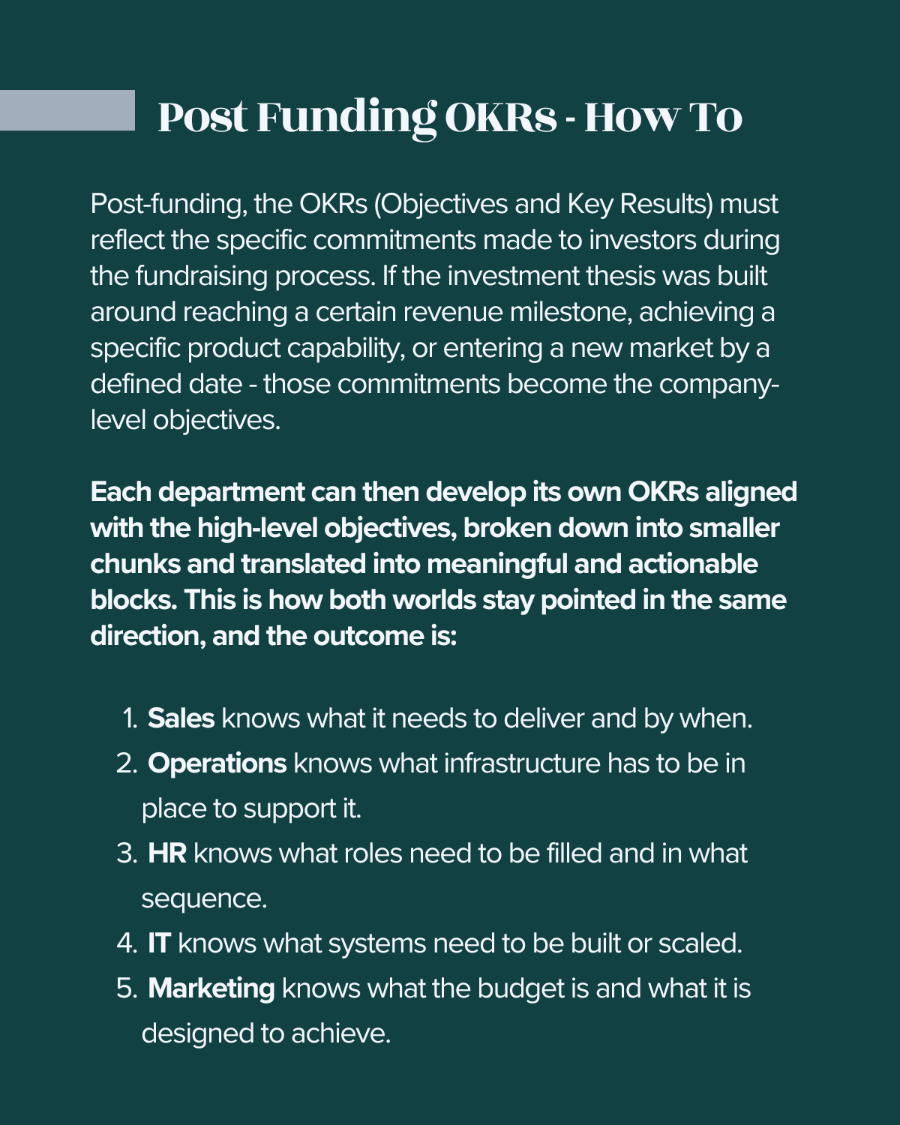
6. No Objectives & Key Results

Teams without defined objectives do not perform in alignment with the company’s goals.

When priorities aren't set, people work hard on the wrong things, and energy and focus are scattered. And we all know that effort should be directed at the desired outcomes.

Specifying the objectives and key results is essential to people engagement, performance, and progress. The leadership ought to break down the yearly company goals and strategy and write quarterly OKRs for each department / team.

7. Burnout

" Always on & available " culture that many startups celebrate in their early stages becomes a disadvantage at scale. Constant overload, pressure, and push cause burnout. It manifests as disengagement, emotional strain, declining performance, and eventually, the contributors who have built the business leave.  

Investment in people's care, well-being, and development is critical. When leadership does not trust and care for their people, they feel it, and often the best ones leave first.

Nowadays, the cost of Hustle Culture extends beyond physical exhaustion, fundamentally eroding mental and emotional well-being and creating a system of auto-exploitation in which individuals internalise work demands as personal moral failures.

The Obsession Most Startups Misunderstand

Here is the uncomfortable truth that most startup founders don't want to hear when they're riding the enthusiasm wave:

— You cannot have stable and growing sales without excellent customer service.

— And you cannot deliver excellent customer service if your operations are not set up for the purpose.

Your front and back house have to communicate and collaborate to make things work well.

  • Pure focus on sales, marketing, and growth — before the operational foundation is in place — is the most common and costly strategy a new business executes.

  • Operations are the systems, processes, SOPs, software, tools, and people — Ideally, these elements are aligned, and you create a customer-centered organisation with smooth operations.

Such a mechanism allows you to scale while having marketing and sales speak directly to the customer/buyer, their needs, pain points, and desires. The reality is that investors don’t put their money into a wobbly structure and reactive management, no matter how compelling the business idea and how impressive the pitch deck.

If you want to scale sustainably, you need to become obsessed with operations and customer service before expanding.

The Real Costs Of Hitting The Wall

When we think about the cost of operational inefficiency, we usually think about delayed logistics, wasted resources, and budget problems. Those are real, yes. However, the highest costs for growing a start-up are:

1. Staffing and People

Every new hire triggers a chain of hidden costs — onboarding, training, lost productivity. When processes aren't documented, and roles aren't clear, that ramp-up period can stretch into months. Add payroll taxes, benefits, and the cost of replacing someone who burned out in the chaos — research puts replacement costs at 50% to 200% of annual salary — and people become your most expensive operational problem.

2. Technology and SaaS

As the business grows, your tech stack quietly becomes a money pit. Cloud bills spike faster than revenue. SaaS subscriptions accumulate — teams paying for tools they don't use, features that overlap, platforms no one audited. Without intentional technology design, you end up paying more for less.

3. Operational and Legal Overhead

Licenses, permits, compliance, equipment, office costs — these don't feel significant until they are. They compound quietly in the background, only showing up during a finance review when you realize how much has been leaking out unnoticed.

4. The Cost Harder To Measure is The Lost Opportunity.  

The expansion that never happened.

  • The existing client didn't renew because delivery was inconsistent and prices increased without an explanation.

  • The new client did not onboard due to a flawed sales process and poor communication.

  • The recommended partnership didn't materialise because the business looked operationally unreliable and leadership was insecure.

  • The market opportunity was missed because the internal situation made execution impossible.

These costs don't appear on a P&L report, but they are factual — and for a fast-growing business, they are often the highest costs of all.

What Fixing Looks like

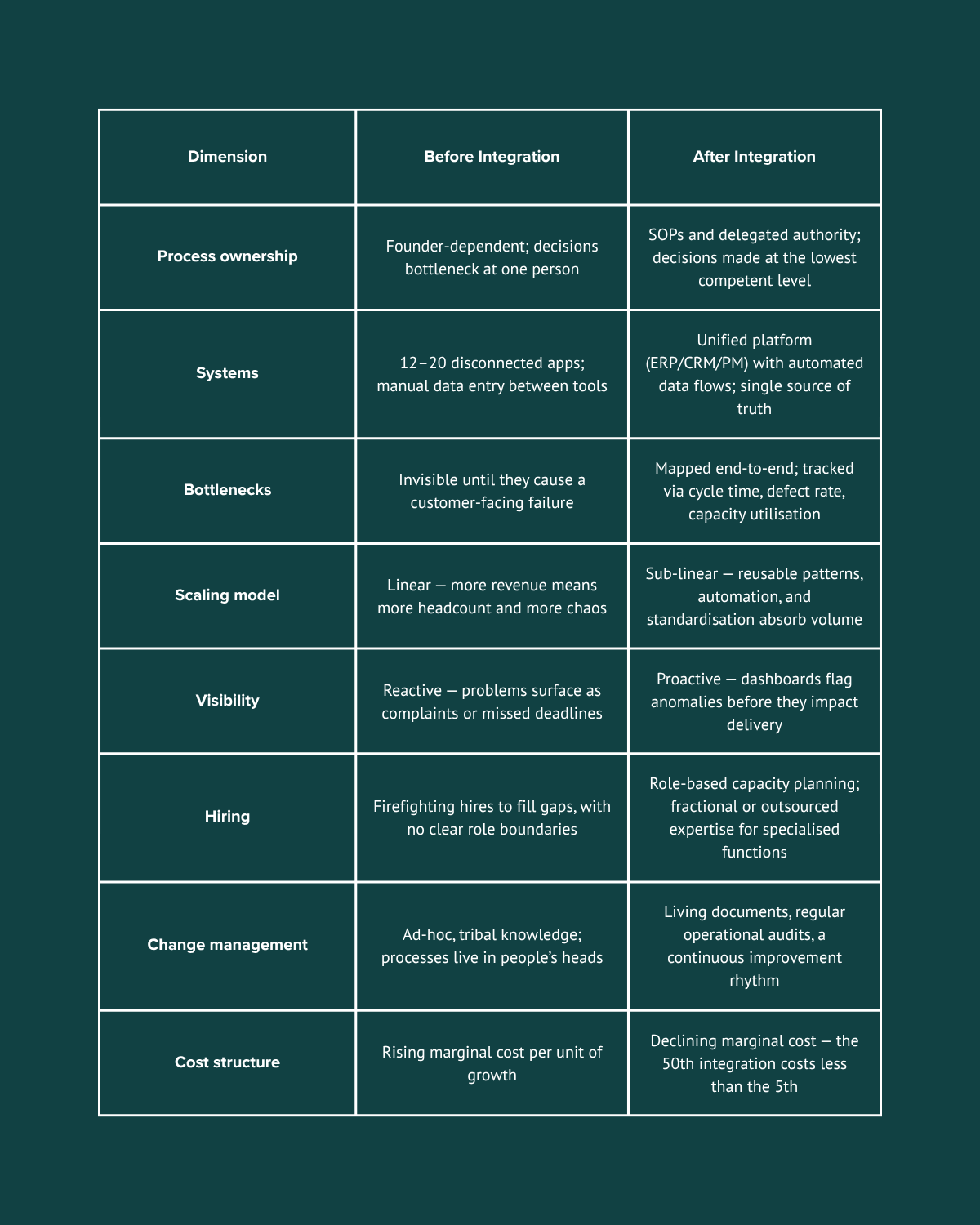
The operational wall is not permanent. It does not mean that a business is broken beyond repair. There are identifiable root causes - poor communication, resource constraints, lack of goal alignment, leadership bottlenecks, and burnout - that can be addressed and dealt with correctly.

Operational walls can be reversed. And with the right approach to business development, they can be prevented entirely.

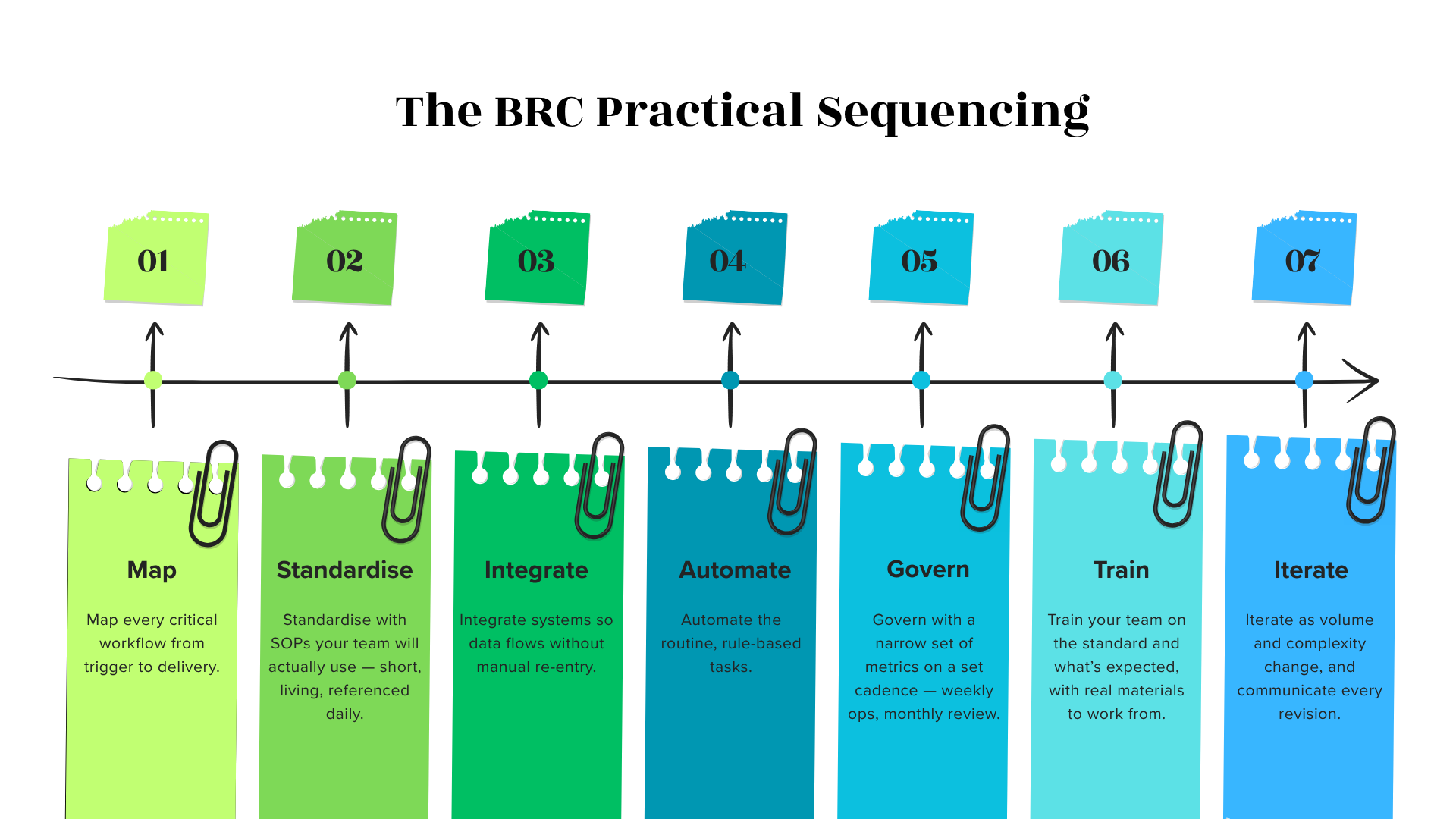
THE FIVE AREAS TO WORK ON

1. Planning and Clear Goals

Vague ambitions don't drive a business, but specific, measurable objectives do. Setting SMART goals — Specific, Measurable, Achievable, Relevant, and Time-bound — and building plans around them give teams direction, prevent overwhelm, and eliminate the scattered energy. When everyone knows what success looks like and how their work connects to it, execution becomes natural.

2. Addressing Root Causes (Not Symptoms)

The most common mistake businesses make when hitting an operational wall is treating the symptoms rather than the cause. Hiring more people into a broken process doesn't fix anything. Adding another tool to a fragmented tech stack doesn't support integration. The first step is always diagnosis (deep dive) — identifying the specific blocks, whether they sit in processes, technology, structure, or leadership — and tackling them directly (i.e. in a resolution workshop).

3. Structural and Operational Redesign

Sustainable improvement requires structural intervention — not just surface fixes. This means redesigning roles and responsibilities to reflect how the business needs to operate, managing workloads to prevent burnout and increasing employee engagement and autonomy. When people have clarity on what they own and the authority to act on it, operational stress drops and performance rises.

4. Leveraging Technology and Data Intelligently

Technology should reduce complexity — not add to it. The right tools, properly integrated, automate repetitive tasks, surface actionable data, and support faster, better decision-making. This requires an honest audit of what's currently in place — what's working, what's duplicating effort, and what needs to be connected or replaced. Data-driven operations are not a luxury for large businesses. They are a competitive necessity for any SME or startup serious about scaling.

5. Communication, Culture, and Continuous Improvement

Regular check-ins, transparent communication and a culture of awareness and continuous improvement help to avoid operational challenges. Recognition matters too — people want to feel seen and supported. Building resilience into your culture is as important as building it into your systems. In essence, dismantling an operational wall requires both strategic planning and human consciousness — focus on workflows and the people who run them. With the right structure, systems and processes, the wall vanishes or doesn't get built.

This is precisely the art of a Business Integrator / Fractional COO / Ops Manager  — not advising from the outside, but working inside the business, identifying root causes, designing the fixes, and building the operational foundation that makes scaling sustainable.

The Question Worth Asking Now

The operational wall is not a sign that a business is failing. It is a sign that a business has grown faster than its systems. Like a baby growing fast and needing new outfits, this is a natural phase of every ambitious enterprise.

The businesses that break through are the ones that recognise the risk of the wall early — before the hidden costs have compounded, before the best people have left, and before the clients have quietly started looking elsewhere.

Is your business approaching the wall — or already hitting it?

Are you ready to explore what avoiding ‘‘it’’ could look like for your business? Book a free 20-minute discovery call.