For founders who’ve proven the product but feel the machine falling apart — here’s how to build the operational layer that makes scaling a managed step instead of a scramble.
You validated the idea. You found product-market fit. Revenue is proving both — congratulations, genuinely; most founders never get this far!

Now you need to prove the machine.
The sequence that gets you here is: Validate → Find product-market fit → then, and only then, build the operational infrastructure to scale it.
Validate → Find PMF → Build Operational Infrastructure sequence
The core shift that you and your team are going through is real - from growth (each revenue gain requires proportional increases in labour, oversight, and exceptions) to scaling (the system handles more volume with stronger efficiency and control).
The Problem: Operations Becomes the Ceiling
This is natural, not a failure on your part: operations becomes the binding constraint right after product-market fit, which is exactly when a start-up transitions into growing-business territory — and the sweet spot when integration becomes the right lever to pull.
The business is generating real revenue with repeat customers, but it’s hitting an operational ceiling. The founder is still the integration layer holding everything together by hand. Headcount is growing faster than capacity. Tool sprawl has set in, and the dots between those tools aren’t connected. Growth is starting to feel like ‘‘ rolling a stone uphill ‘‘, as one SaaS founder put it to me.
Are you experiencing any of these day-to-day?
Queues building up in a specific workflow
Approvals stalling before work can move forward
Materials or tasks piling up faster than they clear
Communication between teams feeling harder than it should
Manual data re-entry between systems
Hand-off delays and dependencies between roles
Confusion in product development (Agile mgmt method)
Procedures that aren’t standardized, so every team does it differently
The Cost of Waiting
Without a process review, deliberate tool selection, restructuring, and integration, this tends to compound into chaos: a structure that wobbles under its own growth, mounting errors, churn, burnout, and people leaving. The financial risk follows close behind — costs climb because sales can’t deliver, because operations can’t keep up, because the underlying inefficiency was never fixed.
The Solution: Redesign First, Then Integrate and Automate
Here’s the distinction that matters most: you redesign the workflow first, and integrate and automate second. That order is the difference between integration that genuinely unblocks growth and integration that just moves the same problem into the next phase of the business.
You don’t need to reinvent operations for every new challenge that shows up as you scale. What you need is one structured, monitored, repeatable operating layer for each function, connected to the bigger picture — so growth becomes a managed step rather than a scramble.
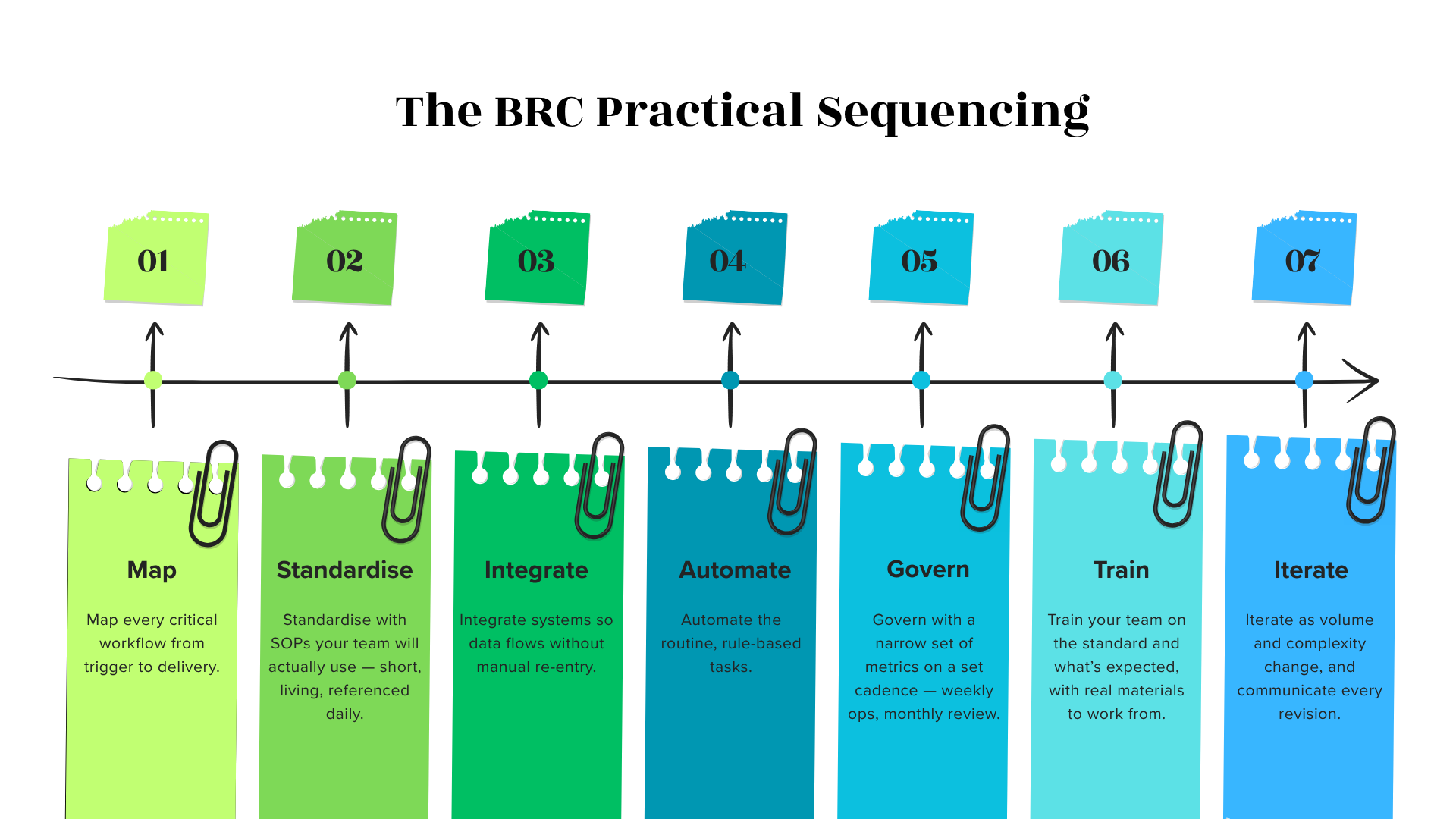
Why Integration Works
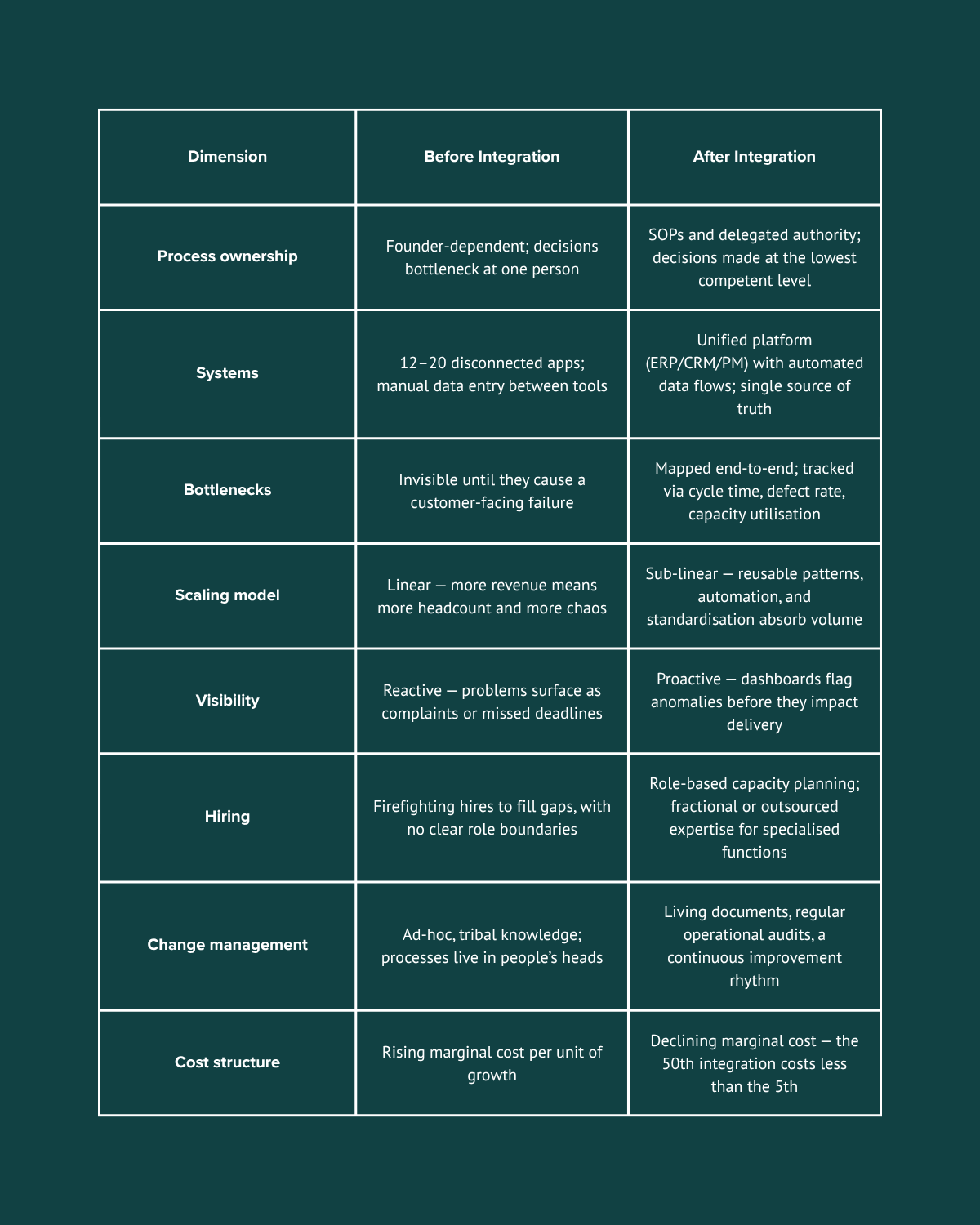
It eliminates compounding friction. Every manual hand-off, duplicate data entry, or approval chain adds a fixed cost per transaction — and that cost multiplies as volume grows. Integration removes the multiplication: once data flows automatically between systems, the 100th order costs the same to process as the 10th.
It creates a single source of truth. Disconnected tools produce conflicting data. When finance, CRM, and operations each hold a different version of “what’s happening,” decisions slow down, and errors creep in. Integration gives every team the same real-time picture.
It decouples growth from headcount. Without integration, scaling means adding people to cover the gaps — more data entry, more coordination, more firefighting. With integrated workflows, the system absorbs volume, and new product lines, markets, or geographies plug into existing patterns instead of requiring new roles.
It makes bottlenecks visible before they’re painful. Integrated data enables dashboards and alerts that flag cycle-time spikes, error rates, and capacity saturation before they show up as missed deadlines or customer complaints — the shift from reactive to proactive operations.
It accelerates time-to-market. When marketing, product, and operations share connected data, feedback loops shorten. Customer signals flow directly into planning instead of relaying through people, so iteration and response to market shifts both speed up.
It reduces error and rework. Manual transcription between systems is a leading source of defects. Automated data transfer eliminates that entire class of error, protecting margin as you scale.
Before & After Integration
Where This Leaves You
You want to scale effectively, but you’re not sure where to start or how to manage it. Maybe one item on that list above is already hitting close to home.
Get in touch, and we’ll review your current phase and needs together, compare notes, and discuss the next steps.
BRC offers embedded execution: a 6–12 month operational partner so visionary founders can go back to what they do best.
Book a discovery call, and let’s talk it through over coffee, tea, matcha, or a protein shake.